How might extreme heat shift the political & policy landscape?
Plus: other climate news, the latest from BC Policy Solutions, and a little more about my dad

Hello friends (and welcome to new subscribers),
I don’t have a new column this week, so instead I’m sharing an assortment of recommended items.
Will extreme heat lead to policy change?
This week marks the 5th anniversary of the catastrophic heat dome event that shattered temperature records in my home province of British Columbia, and took the lives of 619 people – mostly seniors who died, alone, in their overheated homes. Five years later, most of Europe is living through its worse heatwave ever, which is similarly smashing temperature records and stealing lives – an “unnatural” event that, as The Guardian and World Weather Attribution (WWA) project reports, would be impossible without the climate crisis (connecting the dots in a manner that far too few other media reporting does).
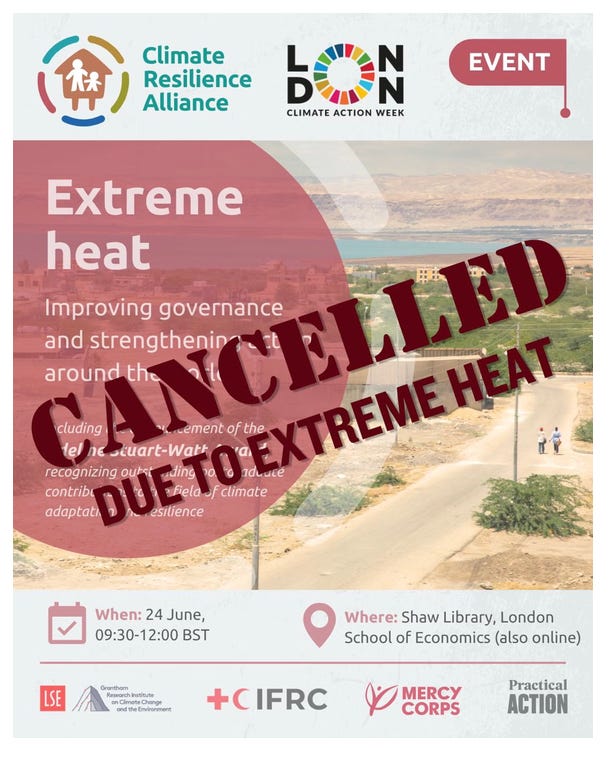
As Professor Friederike Otto, a climate scientist at Imperial College London and a co-founder of WWA, states:
“Scientists like me are beginning to sound like a broken record, reacting year after year to heat extremes that climb ever higher. Yes this is climate change, yes it’s us, yes we have the solutions, no we’re not implementing them fast enough. It’s really now a question of what kind of future we want for ourselves, and whether we’re willing to do what it takes to secure it.”
Honestly, I’ve expected for years now that escalating extreme weather events would galvanize political action on climate. Sadly, we’re still waiting.
That said, sometimes it’s helpful to have a long-term perspective, as Bill McKibben – who’s been in this fight for four decades – surely does. His cautiously hopeful take on this moment – And so ‘climate’ returns – is well worth reading.
So too is Chris Hatch’s climate news weekly round-up, with a special focus on Europe’s brutal heatwave “brought to you by fossil fuels.”
The latest Canadian opinion polling on climate
Earlier this month, the folks at Re.Climate (a national consortium of climate communicators), released their annual survey of the latest Canadian opinion polling on climate. You can find their full report here. And Chris Hatch has a nice summary piece in Canada’s National Observer here. As Chris writes, “Concern is up. Priority is down. Welcome to the climate paradox.”
We are, frustratingly, a bundle of contradictions. We want more action on climate, but we think others don’t share our views. We want to be a renewable energy superpower, but are also okay with more pipelines. As I’ve written previously, part of the problem is low collective literacy on climate, combined with a lack of political and media leadership to change this reality. And part of the problem is that people, understandably, prioritize the emergencies in our lives most proximate in space and time. And so, our task is to draw the connections between these crises.
More climate news, both alarming and hopeful
Two new troubling news stories came out last week about the LNG Canada terminal in Kitimat, BC. First, Sonal Gupta had a disturbing exposé in Canada’s National Observer about how special infrared cameras are capturing shocking pollution levels from the country’s first major LNG export facility. “The footage raises health concerns because some pollutants linked to flaring and LNG processing can affect the lungs, heart and other organs, said Tim Takaro, a physician-scientist and Simon Fraser University professor emeritus in the health sciences faculty.”

And yet, in another great piece of investigative journalism, Zoe Yunker reported in The Tyee that LNG Canada has requested a massive increase in its flaring permit; the company is asking the BC energy regulator for a *ten-fold* increase to its flaring limit. Yikes.
In more hopeful news, however, the Energy Mix reports that a “consumer-led revolution” in Pakistan resulted in the installation of 27 gigawatts of new distributed solar power between 2023 and 2025, an amount that exceeds the capacity of all operating coal-, gas- and oil-fired power plants the country has ever built. This is just one of many stories from Asia that speaks to the massive take-up of solar, and which is throwing into question the future demand for the LNG that Canada hopes to export.

Three new reports from BC Policy Solutions
For those of you in British Columbia, my old shop, BC Policy Solutions (I remain a proud board member), has an impressive three important new reports out this month.
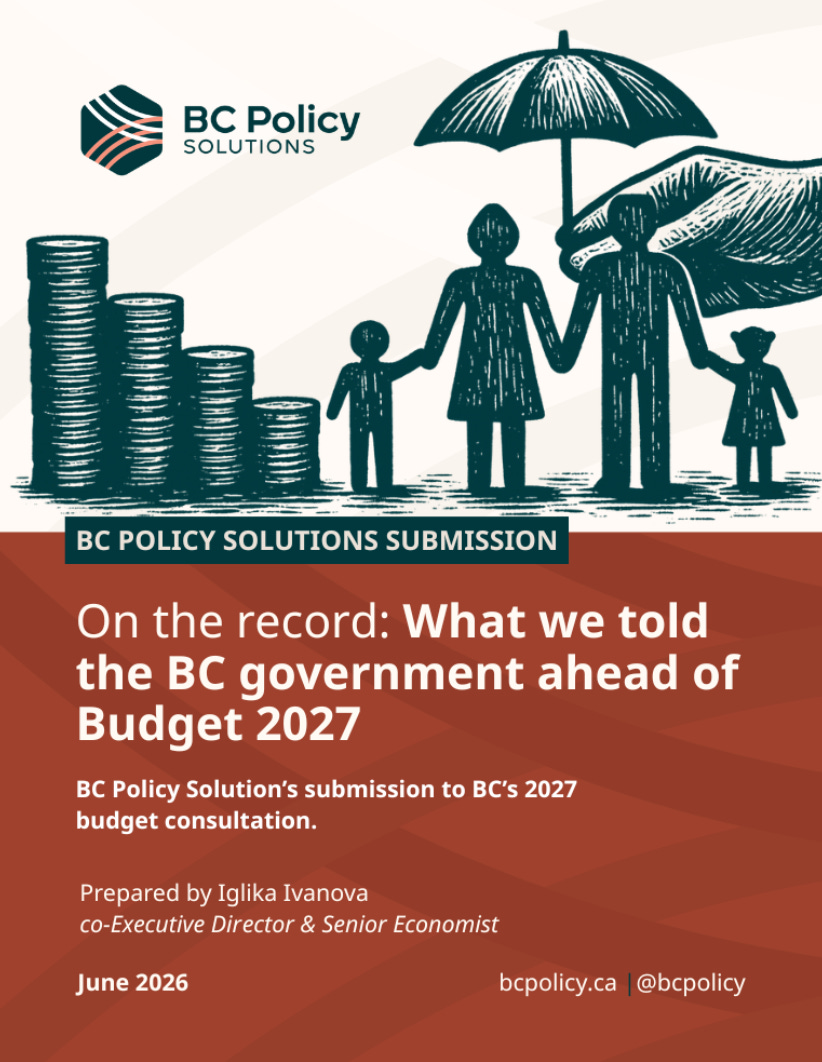
First, you can read their excellent 2027 BC Budget submission (prepared by co-ED and senior economist Iglika Ivanova) – highlighting many options for raising new revenues – here.
Second, on the occasion of the 5th anniversary of BC’s heat dome, BCPS has release a new report by academics Susanna Klassen and Anelyse Weiler entitled Protecting BC workers in a warming climate: Recommendations for WorkSafe BC. You can find it here.
Susanna and Anelyse also published an opinion piece about their report in the Vancouver Sun asking “why doesn’t BC have a trigger temperature to protect workers from extreme heat?” and calling on WorkSafe BC to update its extreme heat protections. You can read the piece here.
And third, Véronique Sioufi, BCPS Racial Equity Researcher and Policy Analyst, has a report out: Rebuilding post-secondary education as public infrastructure in BC (or how we fix the predictable failures of marketization), which you can find here.
A few more memories about my dad
Finally, last newsletter I shared that my dad, Dr. Michael Klein, died earlier this month. My thanks to all those of you who sent kind words. It’s been wonderful to read memories shared by dad’s friends, colleagues and former students on his memorial page here.
This past weekend, to mark his passing, CBC Radio’s White Coat Black Art, with Dr. Brian Goldman, aired an encore edition from eight years ago, interviewing my dad about his medical career and efforts to change how childbirth is practiced in much of the West. It was lovely to hear his voice and insights. I invite you to have a listen here.
That’s all for this week.
**
Let’s break the silence on the climate crisis! Please share these stories on your social media.