
I often get asked how to rebut climate deniers. When this comes up, I tend to offer a few tips. But truth be told, I am less concerned about outright climate deniers than I am about the new climate deniers.
I first wrote about the concept of “the new climate denialism” (with my colleague Shannon Daub) in 2016 here. And the idea later grounded my 2020 book A Good War: Mobilizing Canada for the Climate Emergency.
The essence of the idea is this: while conventional climate denialism simply refuses to accept the reality of human-induced climate change (think Donald Trump), this new form of denialism sees our political leaders assure us they understand and accept the scientific warnings about climate change — but they are in denial about what this scientific reality means for policy and/or continue to block progress in less visible ways. Others, perhaps more kindly, call this “all-the-above policy-making,” the inclination of political leaders to tell the public that we need not make hard choices. Whatever term one uses, the result is the continuing sorry state of Canadian political non-leadership on the defining challenge of our time.
Consider this historic comparison: When the Nazis invaded Poland in September 1939, a line was finally crossed. Britain and France declared war on Germany in response. A week later, so did Canada. And then . . . not a lot really happened.
Historians have dubbed much of the first year of the Second World War “The Phony War.” Neither the UK nor Canada, nor any other nation actually came to Poland’s rescue. No immediate battlefront emerged. For the next nine months, there was not much fighting. Canada got off to a slow start, and Mackenzie King was frequently criticized in those early months for failing to adequately prosecute the war. Indeed, in those early days it remained an open question as to whether Canada would send troops overseas and, if so, to what extent.
The defeat of France in June 1940 changed things. It was a stunning wake-up call and shifted the national psyche. Suddenly, things got much more serious.
And so we find ourselves in a similar awkward interregnum today. Much like Mackenzie King’s government declaring war in 1939 but then not initially doing much, in July 2019, the House of Commons passed a Climate Emergency motion introduced by the Justin Trudeau government, and then proceeded to re-approve a large fossil fuel pipeline (the Trans Mountain expansion) the very next day. Which prompts the question: what will our “fall of France” moment be — the event or series of events that fundamentally shift the popular zeitgeist and makes possible that which feels politically impossible today?
This is the time of our Phony War. Most of us know the battle for our lives must soon get underway. But we’re not quite sure how to begin in earnest. Just like we abandoned Poland to her fate, so too we look away today with uncomfortable shame from parts of the world already experiencing the worst ravages of the climate crisis and extreme weather.
But as with the Second World War, the Phony War will not last.
“No country would find 173 billion barrels of oil in the ground and just leave them there. The resource will be developed,” then prime minister Justin Trudeau famously told an energy conference in Houston, Texas, in March 2017. That’s the new climate denialism
In Canada, every provincial premier, of every political stripe, is guilty of adhering to the new climate denialism. It is now clear, however, that today, our country’s leading practitioner is Prime Minster Mark Carney.
In his early days in office, I was inclined to give Carney the benefit of the doubt. So many voices assured us he was a master at four-dimensional chess. Yes, he was playing nice with Alberta Premier Danielle Smith, but perhaps he was also setting up conditions that couldn’t be met – a requirement that a new pipeline be advanced by a private proponent, and that such a project be paired with a major carbon-capture and storage project that was, in truth, a technical and financial fantasy.
But that was then. It is now clear that Carney is prepared to do everything in his power to see this pipeline project succeed. His response to Alberta: appeasement and acquiescence, now with billions of dollars in public subsidies.
Carney’s team has started to produce regular videos of the prime minister called “Forward Guidance.” A modern reboot of President Roosevelt’s “fireside chats,” each video features Carney speaking forthrightly, directly to Canadians, about a big issue. A couple months ago, he issued an episode on “Canada’s Energy Future.”
The video is a perfect manifestation of the new climate denialism. In it, Carney speaks about how, “Climate change is worsening, with bigger storms, heavier flooding, more devastating wildfires.” And he warns of “a climate crisis that’s burning our forests and threatening our kids’ future. We need an energy transition that really works.” He offered a history of the development of hydro electricity. See, he gets it.
But then he warned about how fights over some sources of energy (namely the oil sands) have divided us. “I’ve acted as Prime Minister, to the best of my abilities, to help put those divisions in the past, by focusing on what we can build together for the future.” Uh-oh, one senses a pivot coming. “I don’t want to know what people are against,” says Carney, “but what they are for.” So don’t tell him what you oppose; that’s passé.
And then the kicker, a classic old-school all-the-above plan: While Carney wants to see more electrification and renewables, “The truth is, nobody knows how long the global economy will rely on conventional energy, but while it does, as much of that energy as possible should come from Canada, produced responsibly and with a clear focus on lowering emissions over time.” With that, Carney makes the case for a second oil pipeline to the Westcoast, for an expanded LNG industry, and for more nuclear power.
Finally, Carney offered this:
“I promised you I wouldn’t sugarcoat tough messages. The climate plan we inherited from the previous government [meaning, the Trudeau Liberal government] was well-intentioned and well-suited for the times in which it was designed. The climate crisis is still with us, and our commitment to fighting it is absolute. But the certainties of the world of 2015 are long gone. Our neighbourhood hasn’t been this hostile since Canada was founded. The world hasn’t been this unstable geopolitically since the end of the Second World War. We must establish stability amidst this chaos…
We can’t afford to restrain the growth of an important part of our energy mix, oil and gas, to meet a short-term goal. I want to be clear on this point. The changes we have made will mean that our emissions will be higher in the next few years than they were projected to be under the previous government’s plan. But in my judgment, that plan was not sustainable over the long term. It would have been too expensive for Canadians, Canadians who are already struggling with affordability.” [emphasis mine]
And that, my friends, is the new climate denialism to a tee, with an Orwellian spin on “sustainability” and utter defeatism with respect to how to jointly tackle the affordability and climate crises.
This week, adding fuel to the fire, the Carney government tabled the “Building Canada Strong Act”, an omnibus 200+ page piece of legislation that seeks to expedite new energy projects, liberates these projects in “special zones” from all manner of federal environmental review, and strives to place roadblocks in the way of any efforts by Indigenous nations, environmental groups or organized labour who may oppose the government’s efforts to bulldoze through these “projects of national interest.”
For critiques of this act, I recommend this response from Environmental Defence, and this response from the Canadian Labour Congress to the bill’s attack on the right to strike.
And for more on Carney’s shredding of Canada’s climate plan, see my earlier piece here.
When comparing the old-school climate deniers like President Trump to the new climate deniers, which are more responsible for blocking and slowing progress on this fight of our lives, and which are the greater arsonists? Likely a toss-up.
**
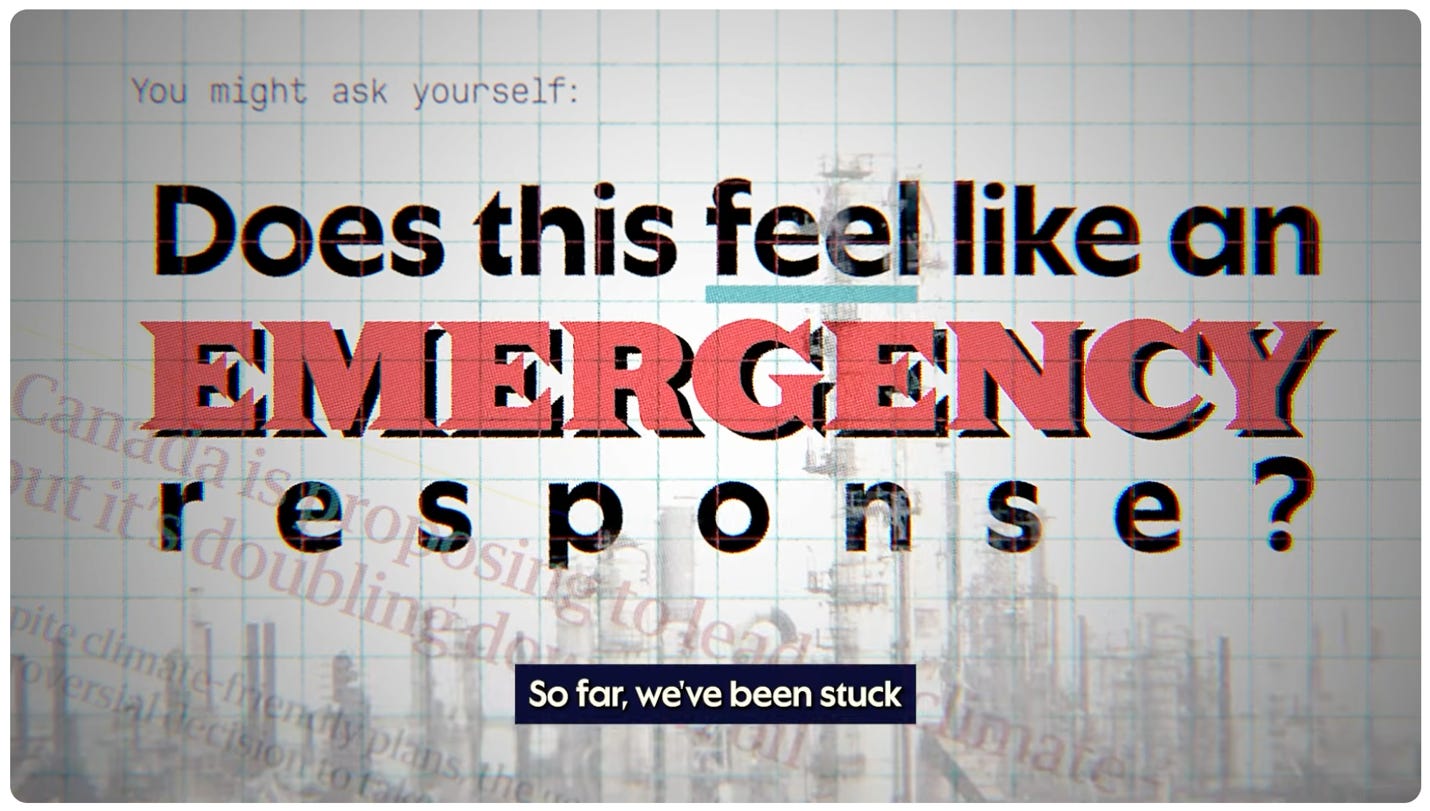
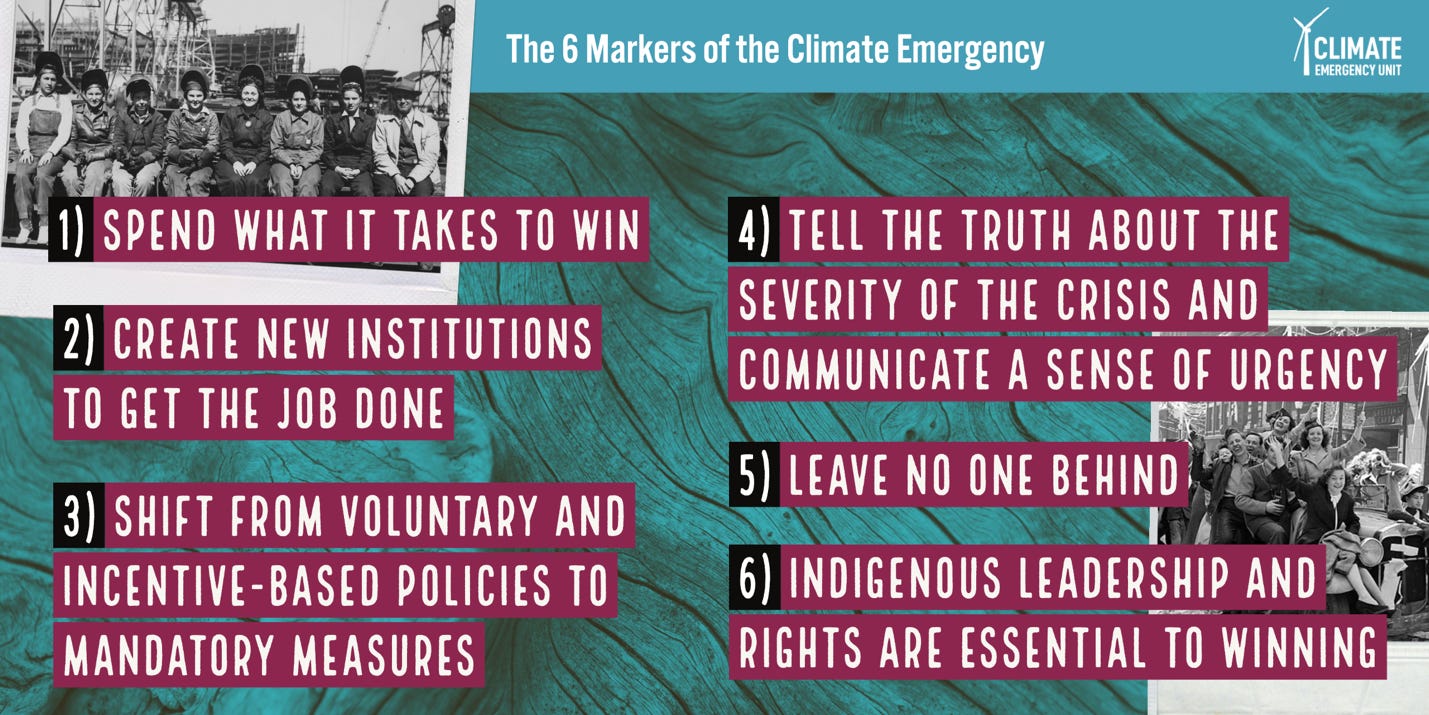
In contrast to the new climate denialism, if you want to know what a genuine climate emergency plan looks like, check out this 12-minute video we at the Climate Emergency Unit produced late last year: 6 Markers of Climate Emergency.
There may not be a 'Fall of France' moment, unfortunately, because people are simply better at understanding the threat of an army than of weather getting worse. The Heat Dome incinerating Lytton didn't do it, and the smoke suffocating Toronto didn't do it, and the fire burning down Fort Mac didn't do it. It burning down a city doesn't do it, I don't know what would.
But if there is a 'Fall of France' moment, it will probably be some kind of activism that sets off a movement, like Greta Thunburg's school strike. That juiced the climate movement until Covid intterrupted everything. It was gaining momentum, too--after the climate strike, there was going to be a huge action taking money out of banks.
There needs to be a person with a big platform (looking at you, Avi Lewis) who simply proposes bold policies in a really high-profile way. A lot of people think climate change is bad, but they don't think others agree with them, so they're fatalistic. The right political shock could change that equilibrium.
PM Carney’s written and voiced knowledge of climate change is too clear to call him a climate denialist. He knows, and further, he knows that we have passed the tipping point beyond which humanity’s climate fate is sealed. Canada owns only a tiny piece of the world and our fate is determined in small part by what we do and largely by what is happening world-wide. So, I think Carney’s has decided to stop fighting and to lead Canada to the most comfortable position in an otherwise failing world. Sad to say, but happy that there are people like the Klein siblings who are thinking and acting about how to make the climate fight more effective.